
Article · 9 Nov 2026 · 15 min read
Bamboo in Contemporary Architecture
Material selection, preservation, joinery and construction details: a practical architectural material research guide.
Introduction
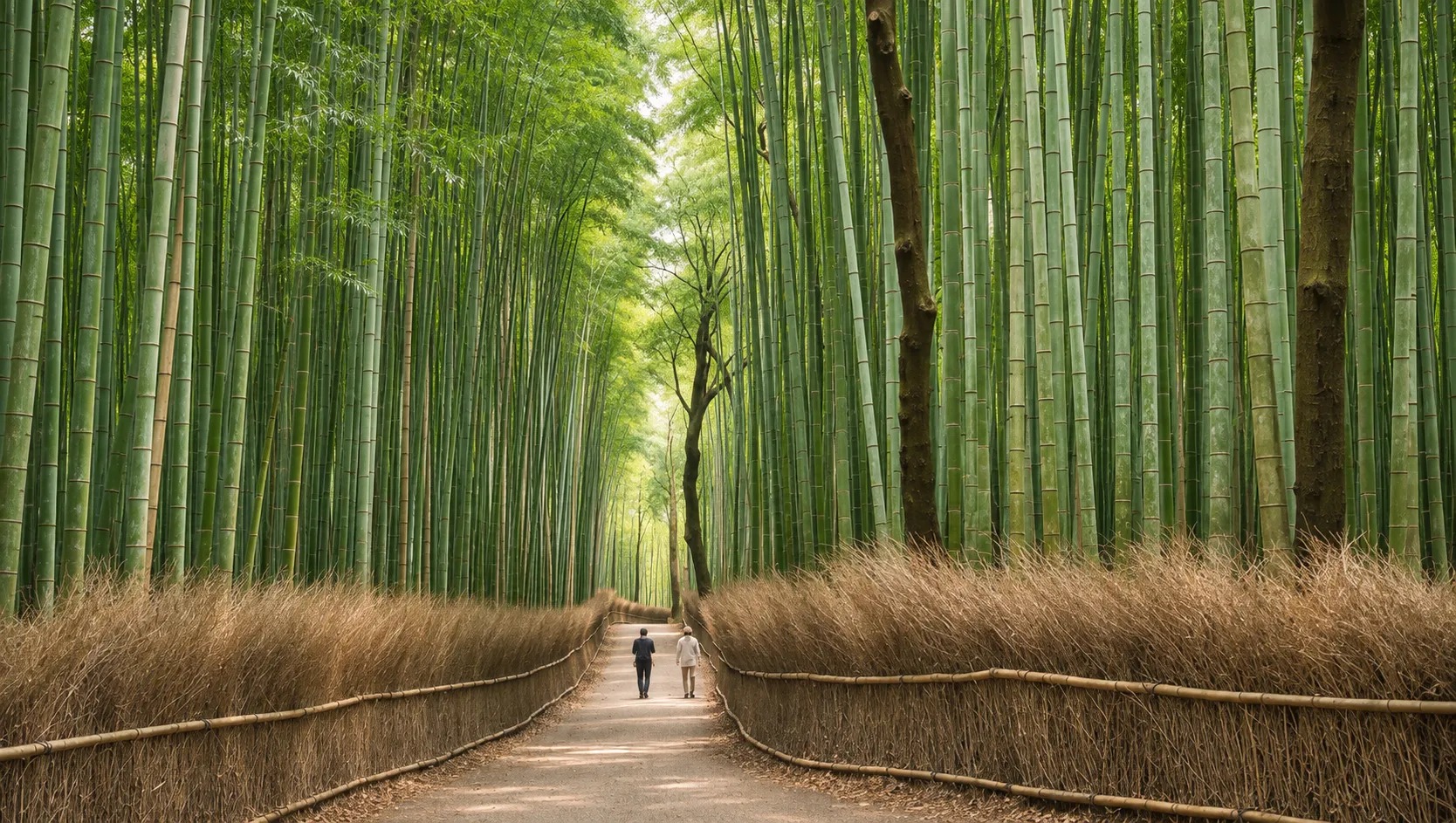
Architecture is increasingly exploring materials that can connect built environments with natural systems.
Bamboo is a renewable, fast-growing material with a distinctive linear character, making it relevant to contemporary architectural expression when selected and detailed appropriately.
Its applications can range from screens, ceilings and furniture to pavilions, lightweight structures and landscape elements. However, successful use depends on understanding the species, maturity, moisture condition, biological durability, treatment, connections and maintenance requirements.
Bamboo is a hollow, node-based natural culm. Its properties vary with species, age, growing conditions, culm position and moisture content. Unlike standardized industrial products, each culm should be inspected and graded before use.
In architecture, bamboo can contribute texture, warmth, rhythm and filtered light. It can also be combined with concrete, exposed brick, stone, glass and timber to create a contemporary material palette.
- Subject
- Bamboo in contemporary architecture
- Focus
- Selection, preservation, joinery and construction details
- Prepared by
- Ar. Chirag Goti, Gyan Architects
- Reference
- Gyan Architects Bamboo Report
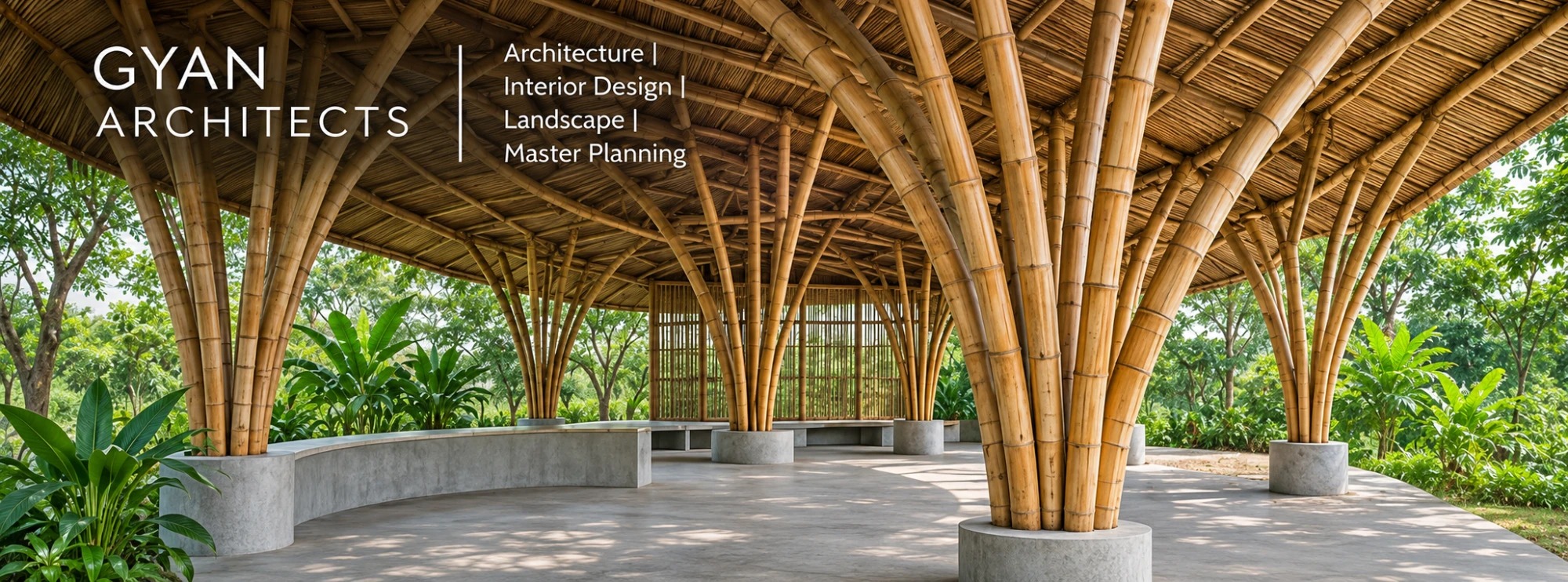
“Each culm is different, so each culm should be inspected before it is used.”
02 · Species
Four species, one careful decision.
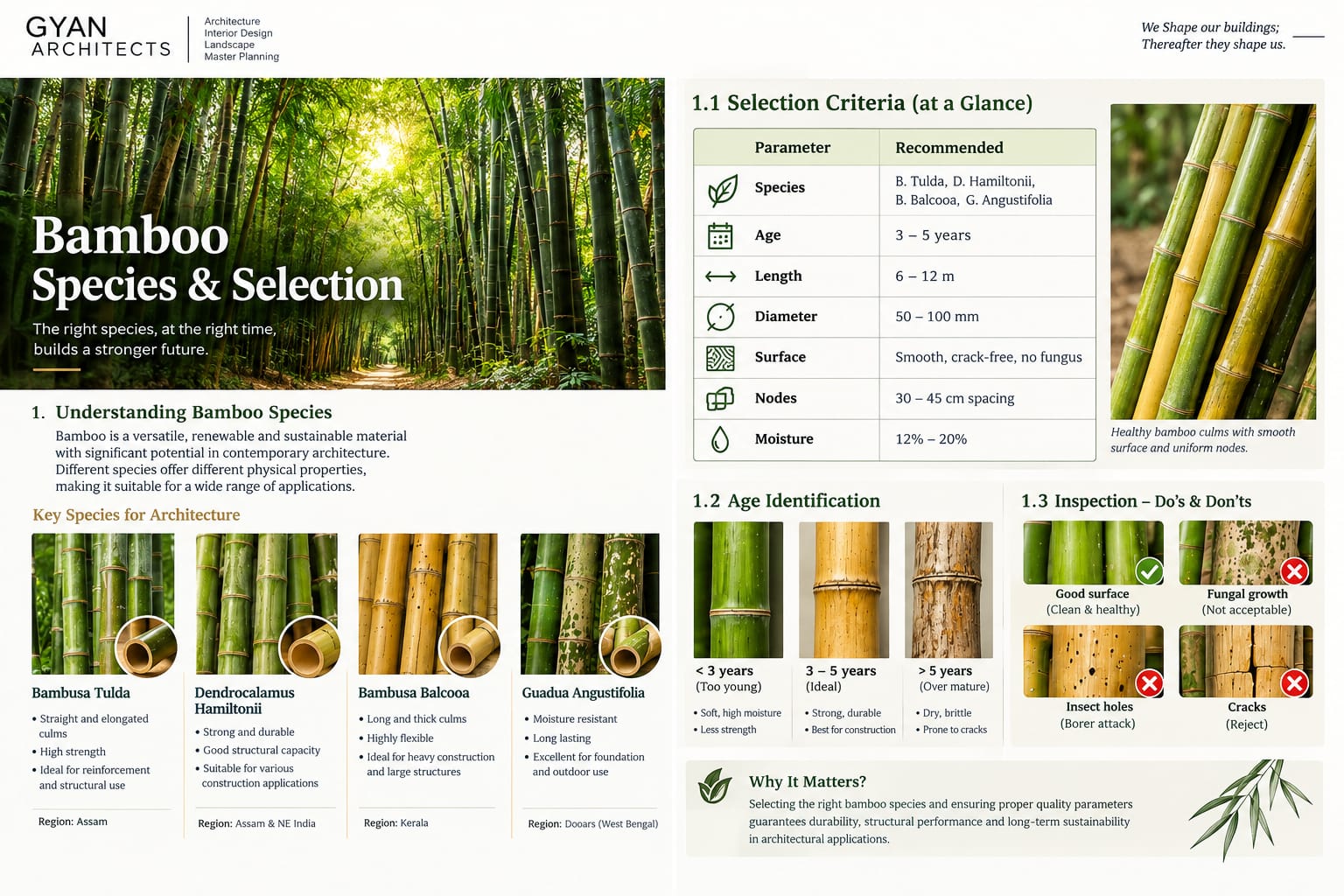
Our Bamboo Report points to four species for architectural use. Species selection must be confirmed with local availability, verified material properties and the intended application. The regional sourcing notes in our reference should be treated as preliminary guidance rather than a substitute for supplier and laboratory verification.
- Bambusa Tulda
- A straight, elongated option, with potential for reinforcement-related applications.
- Dendrocalamus Hamiltonii
- A strong and healthy variety, suitable for different construction applications.
- Bambusa Balcooa
- A robust variety with potential for heavier construction applications.
- Guadua Angustifolia
- Moisture resistance and durability are the characteristics noted as relevant.
03 · Selection
What to check before procurement.
Our Bamboo Report recommends assessing the following parameters before procurement.
- Age
- Approximately 3–5 years is the preferred maturity range.
- Length
- 6–12 metres, subject to species and application.
- Diameter
- 50–100 mm as a reference range for construction selection.
- Surface
- Select culms without visible cracks, fungal stains or insect damage.
- Nodes
- Healthy nodes and reasonably consistent spacing.
- Moisture
- 12–20% as a reference range; confirm the project specification and applicable standards.
04 · Age and inspection
Reading maturity, and inspecting every culm.
The reference guide suggests assessing bamboo maturity through colour, surface condition, weight and sound. It describes younger culms as greener, mature culms as more yellow or ochre, and older culms as potentially darker or greyish. These are indicative observations only; age should be confirmed through traceable harvesting records wherever possible.
Inspect each culm for fungal discolouration, small borer holes, powder deposits, cracks, splitting, deformity and other signs of biological or mechanical damage. A moisture meter or oven-dry test may be used to assess moisture content.
Inspection checklist
Six checks for every culm, recorded against its batch.
- Inspect
- The full culm length
- Check
- Nodes, cracks and end splits
- Look for
- Fungal stains and insect holes
- Check for
- Powder deposits or borer activity
- Measure
- Moisture at representative locations
- Record
- Batch number, supplier, date and inspection result
“Preservation must be planned as part of the material specification, not treated as a last-minute site operation.”
05 · Natural treatments
Preservation starts with the specification.
Bamboo is susceptible to biological deterioration when moisture and nutrients create favourable conditions for fungi and insects. The treatments below are methods reported in our source document; verify their effectiveness and suitability before specifying them.
Salt-water soaking
Mix 300–500 g of salt in 10 litres of water, soak the bamboo for 24–48 hours and then shade-dry for 2–3 days.
Lime coating
A paste of one part lime powder and four parts water, applied uniformly and shade-dried. It can be gently removed with sandpaper where required.
Garlic–chilli spray
A natural repellent option, but its effect may be weaker and slower than chemical treatments. It should not be assumed to provide structural-grade preservation.
Coconut oil
A thin layer brushed onto the surface and shade-dried. Confirm compatibility with finishes, adhesives and the intended exposure.
06 · Chemicals and coatings
Where chemistry is involved, specialists decide.
Borax and boric acid
A solution of 1 kg borax and 1 kg boric acid in 6 litres of water, with 24-hour immersion followed by shade drying. The stated concentration and handling method require review by a qualified preservation specialist and compliance with product safety instructions.
Cypermethrin-based spray
A pesticide treatment, to be considered only where legally permitted, with a registered product, label-compliant dilution, PPE, ventilation and professional application. Do not rely on the generic dilution in the source without product-specific confirmation.
Bitumen coating
Use only where compatible with the design, health and environmental requirements; consider appearance, adhesion, fire behaviour and future maintenance.
Treatment workflow
Whichever system is chosen, the workflow is the same.
- 1
- Identify species and intended use
- 2
- Inspect and reject damaged culms
- 3
- Confirm moisture and treatment specification
- 4
- Apply the selected system under controlled conditions
- 5
- Dry and condition the bamboo as specified
- 6
- Record batch, chemicals, concentration, date and operator
07 · Drying and storage
Dry in the shade. Store with air around it.
The guide recommends drying bamboo in a shaded, well-ventilated location and rotating the culms periodically. Storage should protect the material from direct rain, ground moisture and prolonged wetting while allowing airflow.
Before installation, confirm moisture content, surface condition, treatment records and dimensional consistency. Keep inspection records for each batch and retain representative samples where project quality procedures require them.
08 · Joints: lashing and bolts
Joints decide how bamboo behaves.
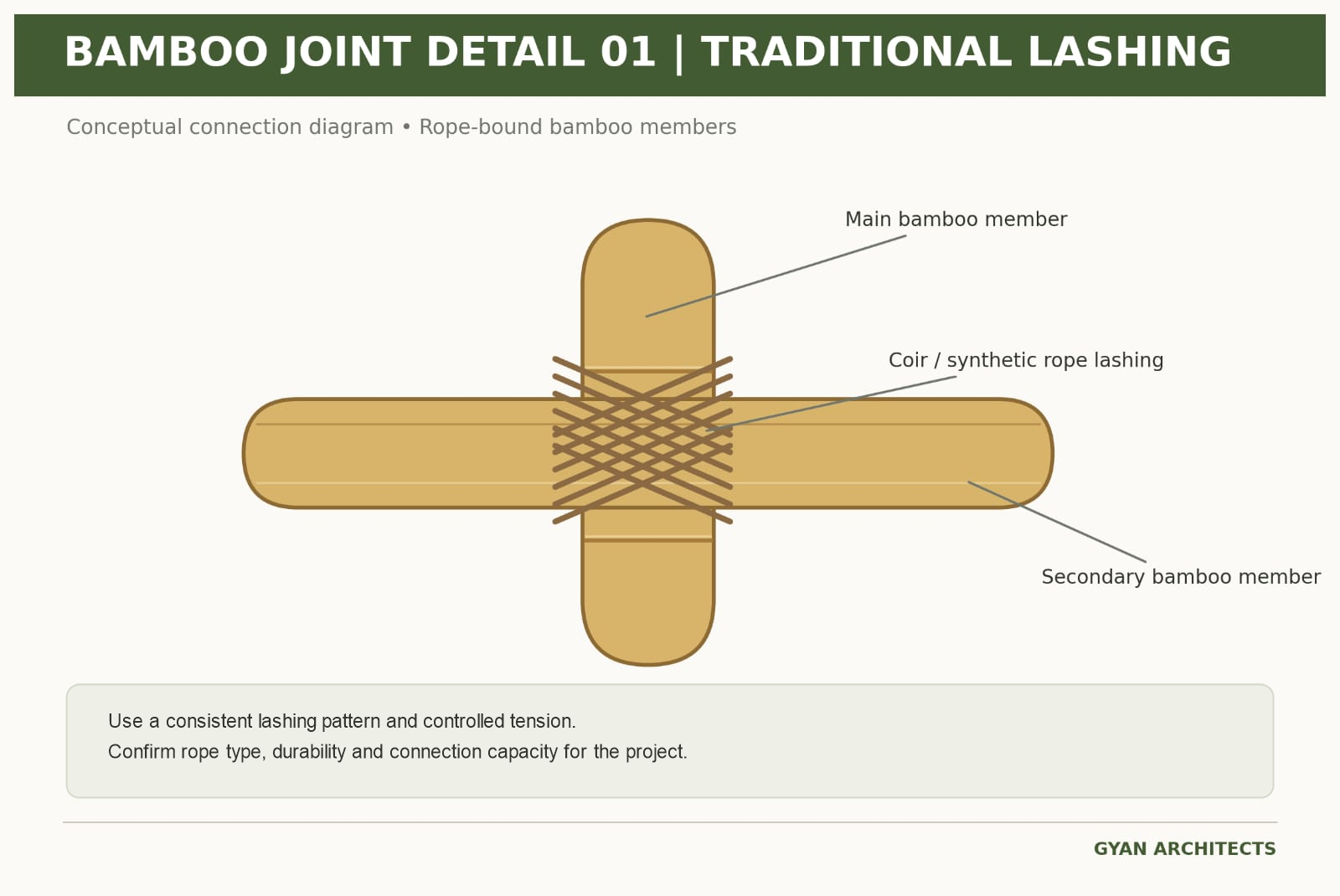
The following diagrams are conceptual architectural sketches intended to explain common connection principles. They are not fabrication drawings or engineered connection designs. Final joint geometry, fasteners, plate thicknesses, edge distances, bearing, splitting resistance and load paths must be designed and verified by a qualified structural engineer.
Traditional lashing joint
A rope-lashed connection. Lashing material, pattern and preload should be selected for the design loads and exposure.
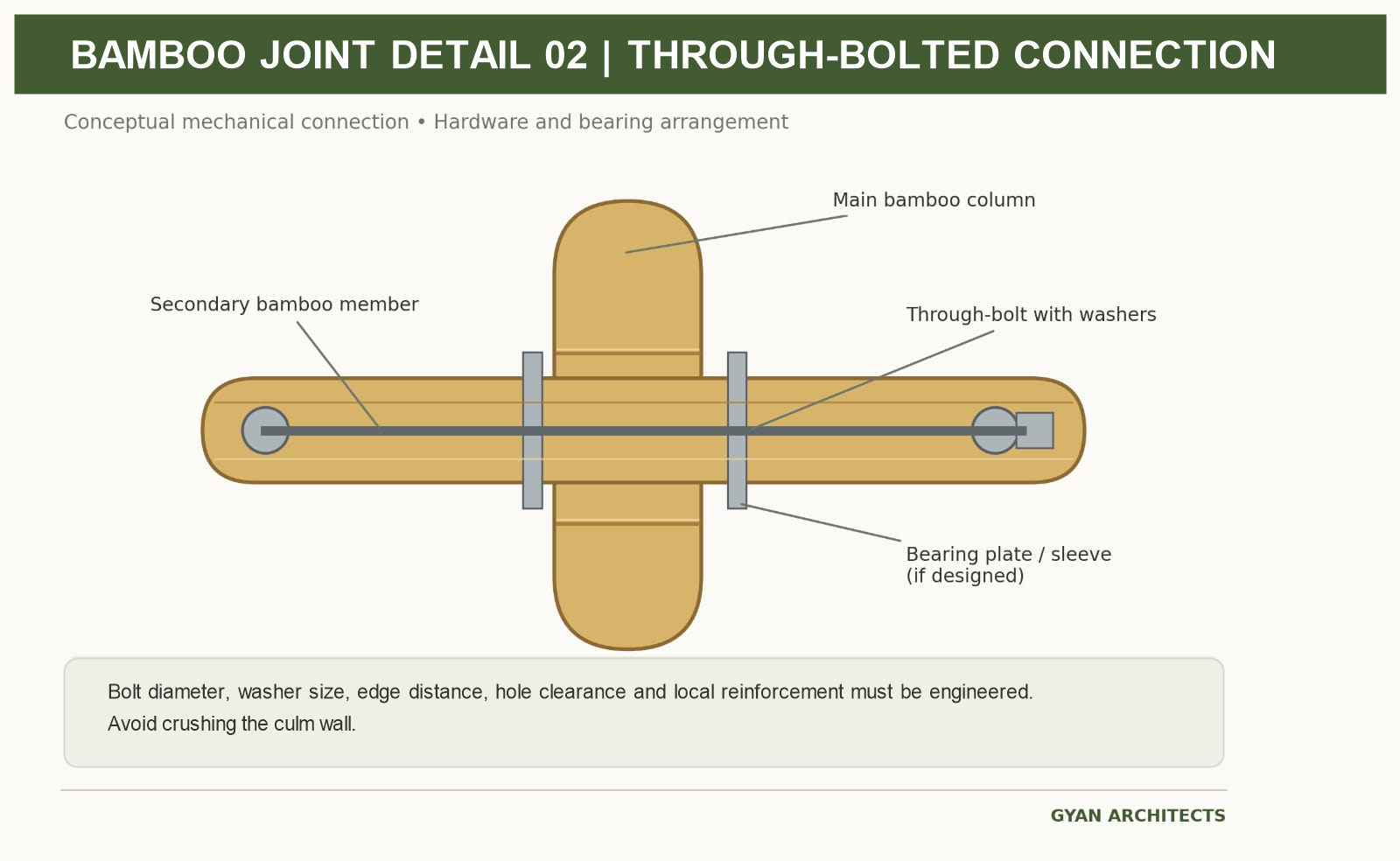
Through-bolted joint
A bolted connection concept. Bolt diameter, spacing, washers and local bearing reinforcement require structural design.
09 · Joints: pins and plates
Pins, plates and bearing.
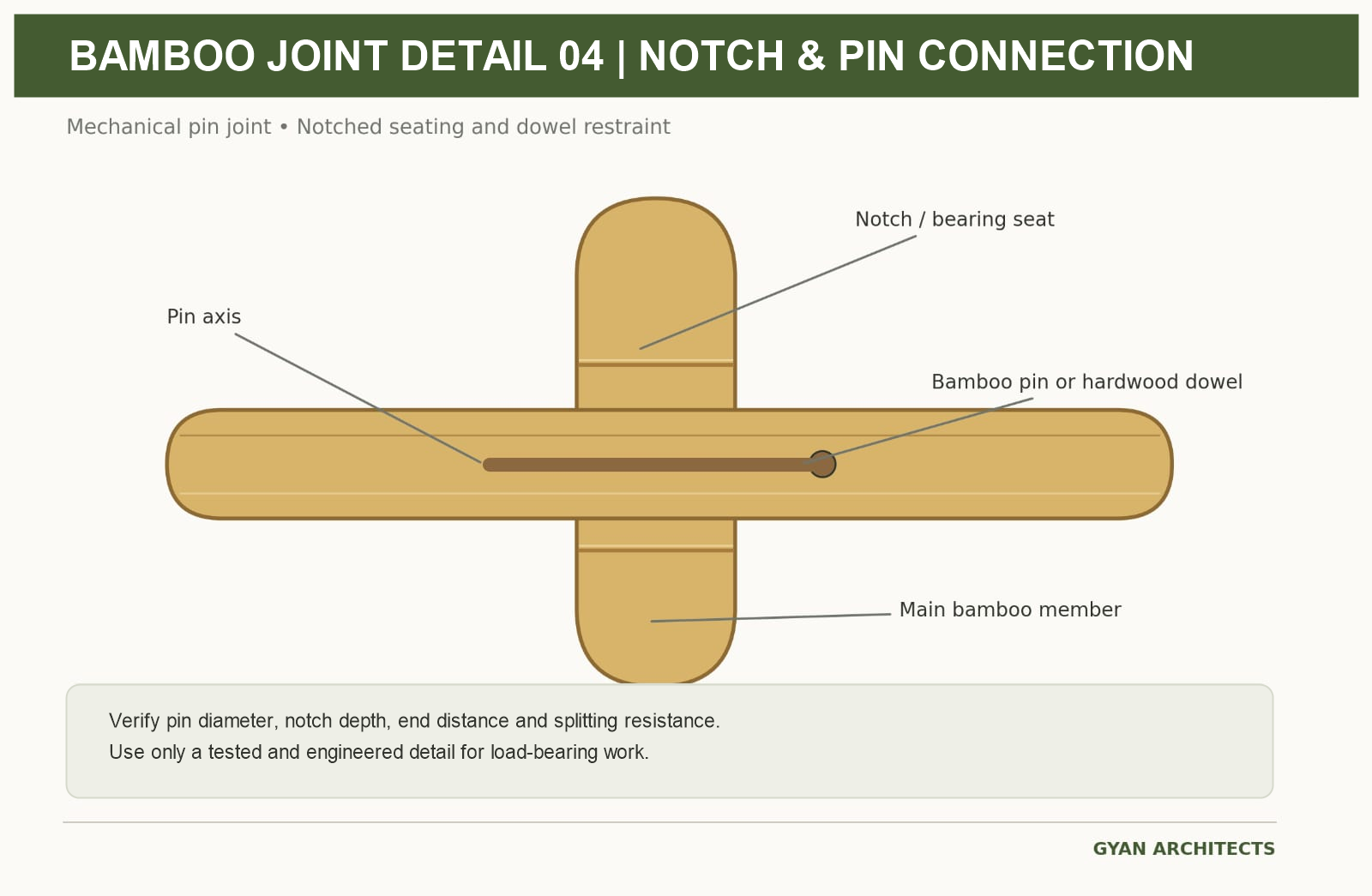
Notch-and-pin joint
A mechanical pin connection concept. Notch depth, pin material and splitting resistance need engineering verification.
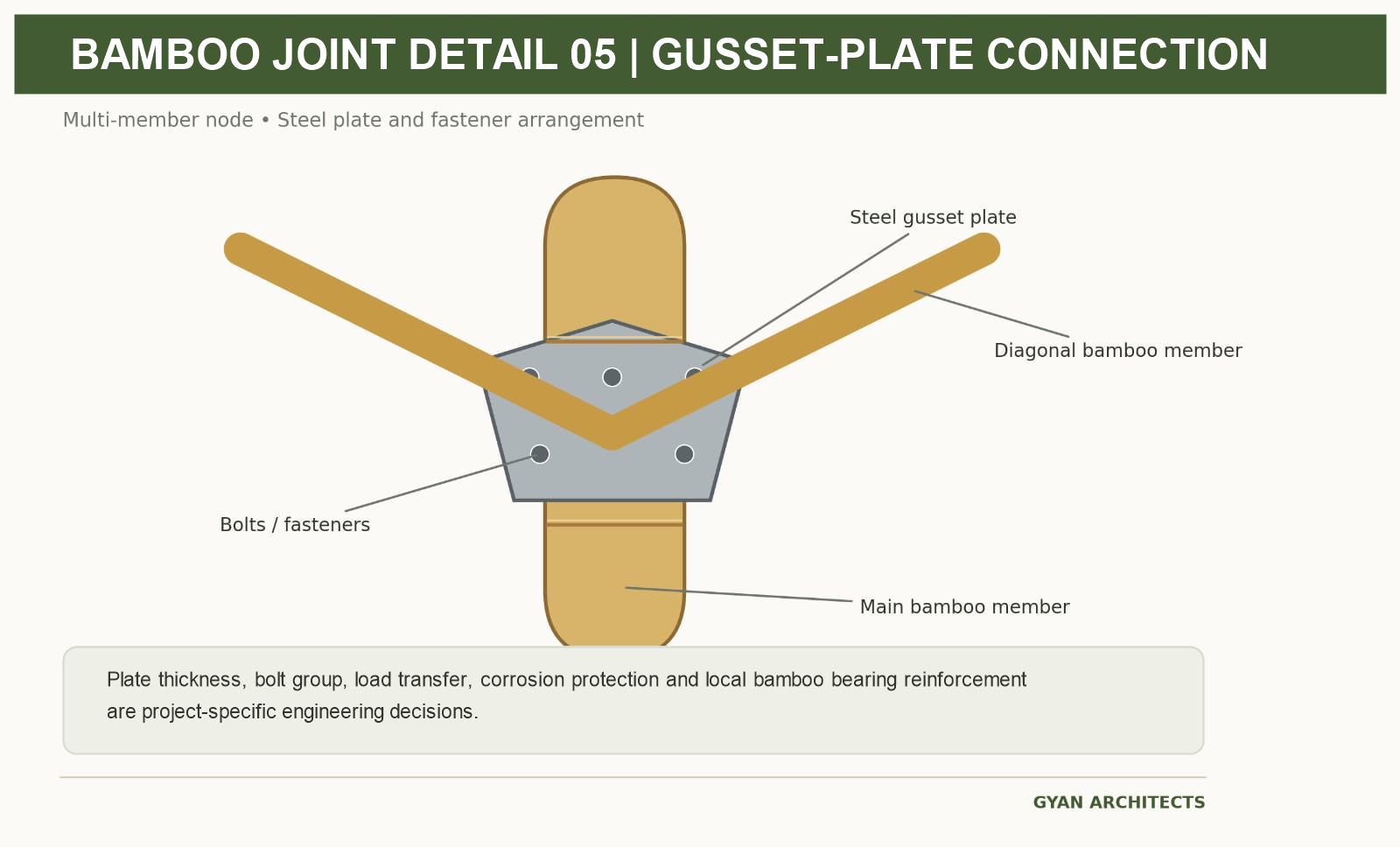
Gusset-plate joint
A gusset-plate node for multiple members. Plate thickness, fastener group and corrosion protection are project-specific.
“Keep bamboo clear of soil and standing water.”
10 · Joints: base and roof
From the ground to the ridge.
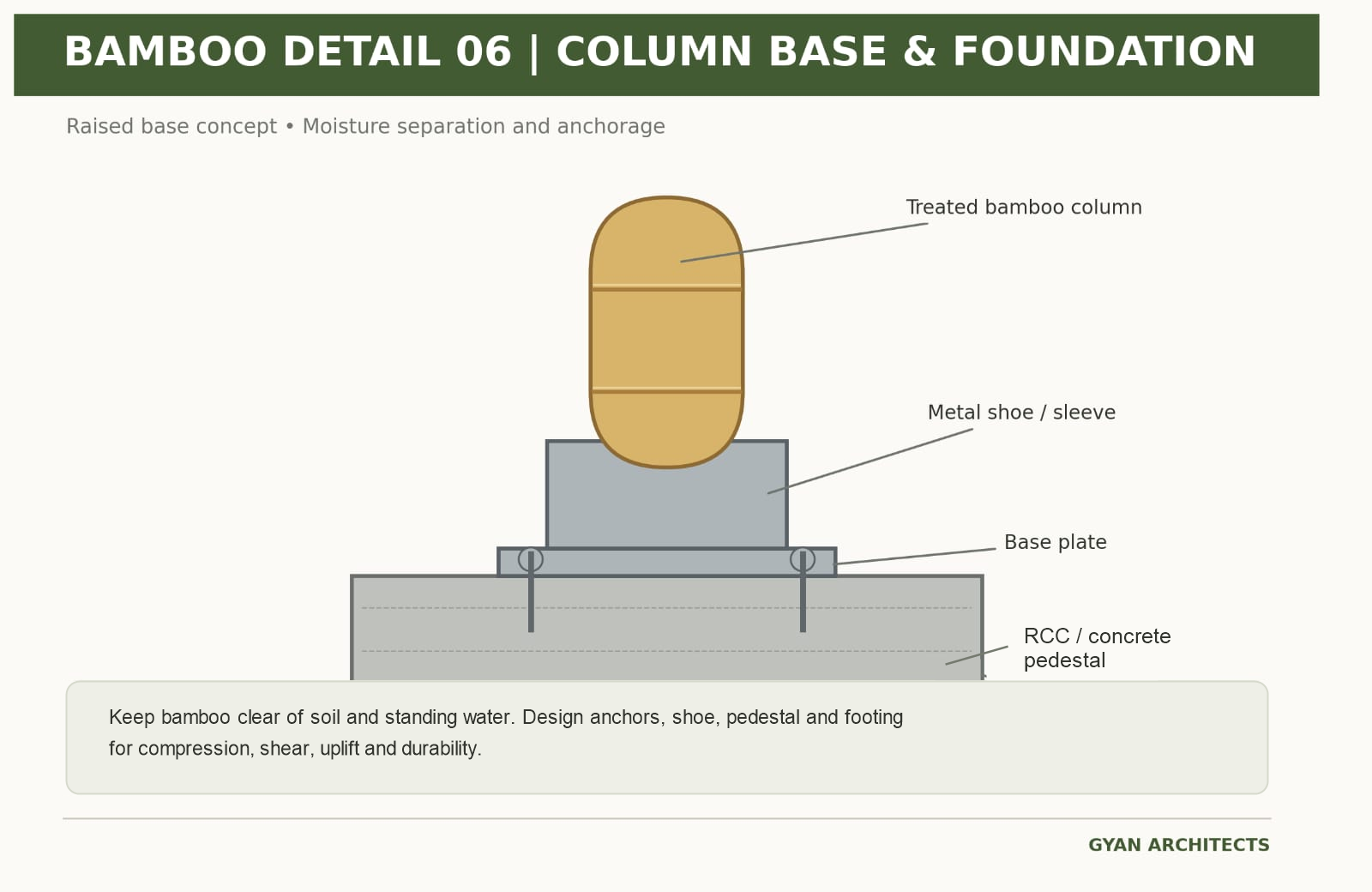
Column base detail
A raised base separating bamboo from ground moisture. Anchor bolts, pedestal and shoe must be designed for uplift, shear and compression.
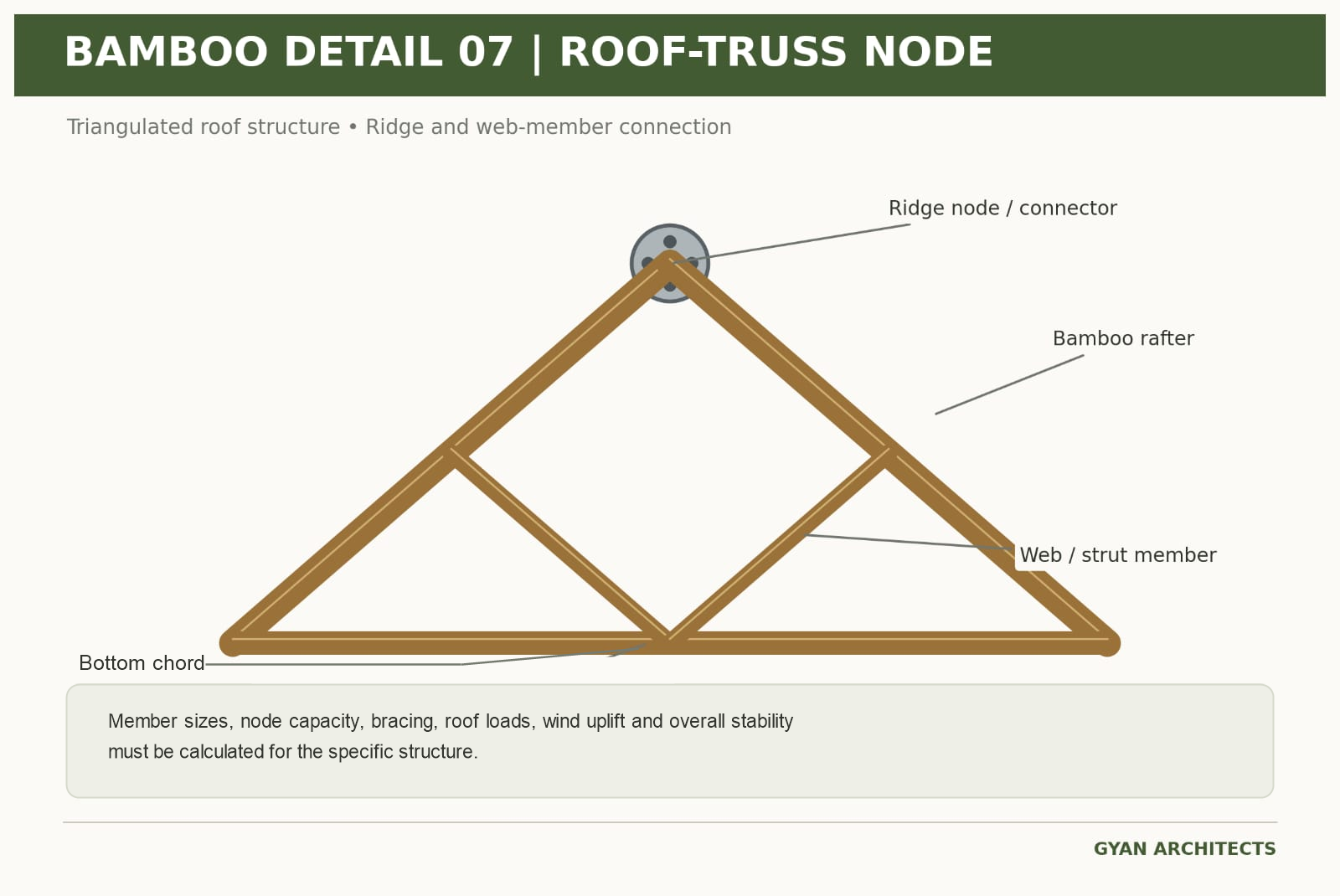
Roof-truss node
A simple triangulated roof-truss arrangement. Actual member sizing, bracing and node design require structural calculations.
11 · Walls and eaves
Keep it dry, ventilated and replaceable.
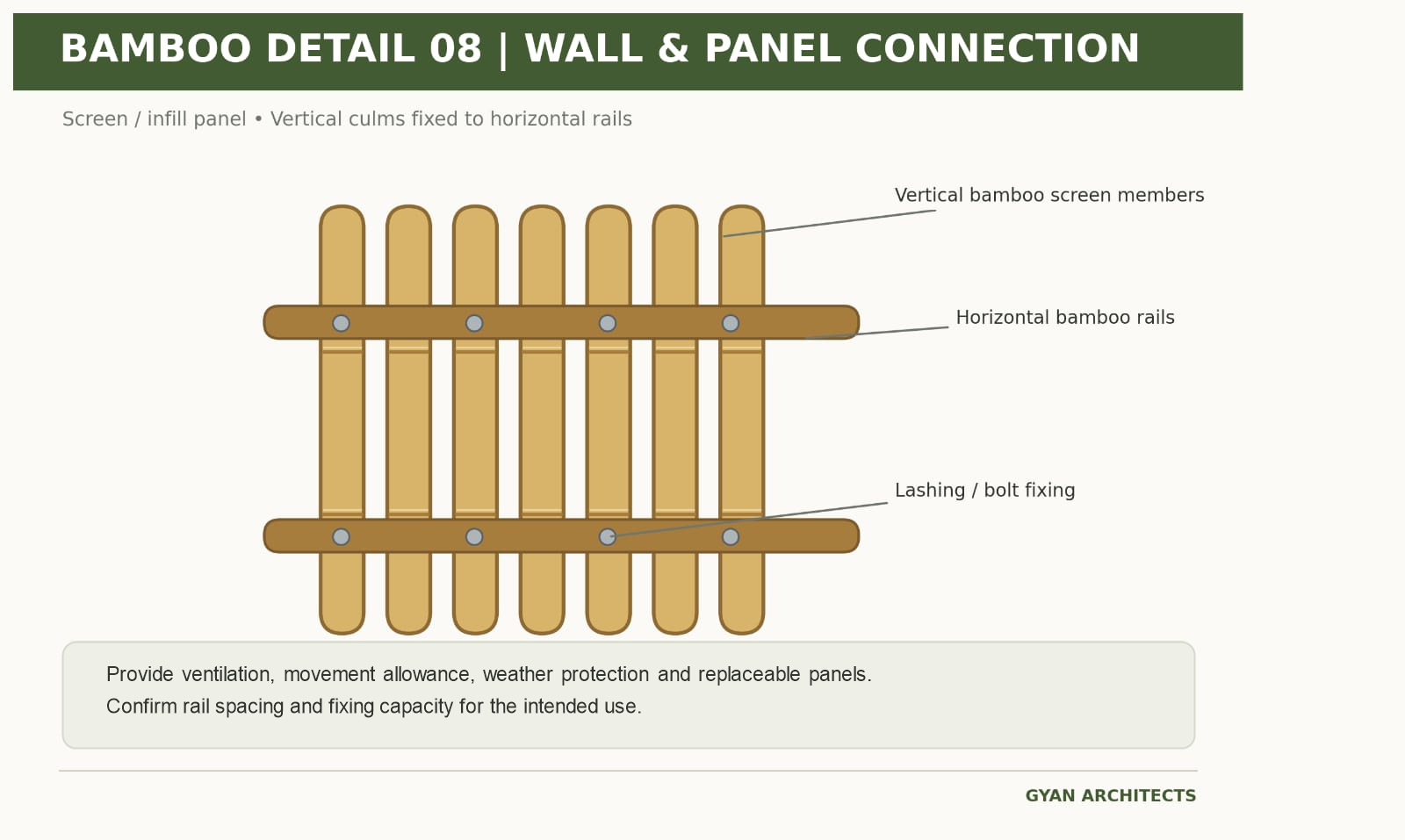
Wall and panel connection
A screen or panel using vertical bamboo members fixed to horizontal rails. Provide suitable fixings and weather detailing.
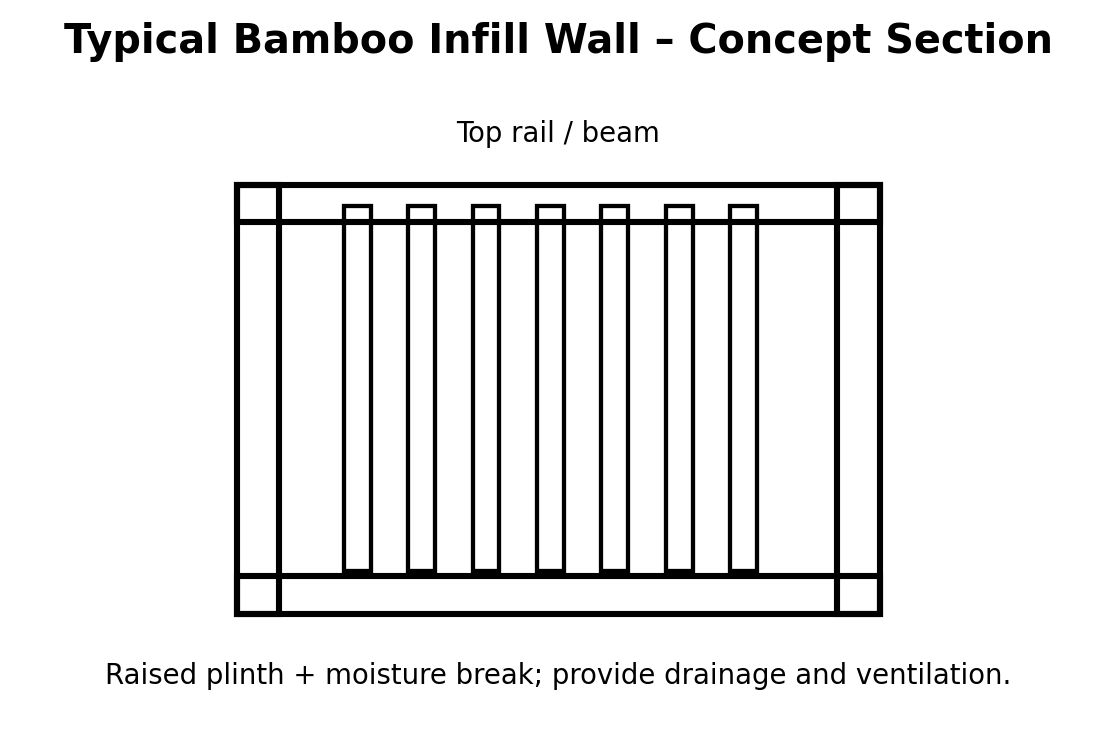
Bamboo infill wall
A bamboo infill wall should be detailed to manage rain penetration, drainage, ventilation, movement and replacement. Keep bamboo separated from direct soil contact and standing water. Provide a durable base and inspectable connections.
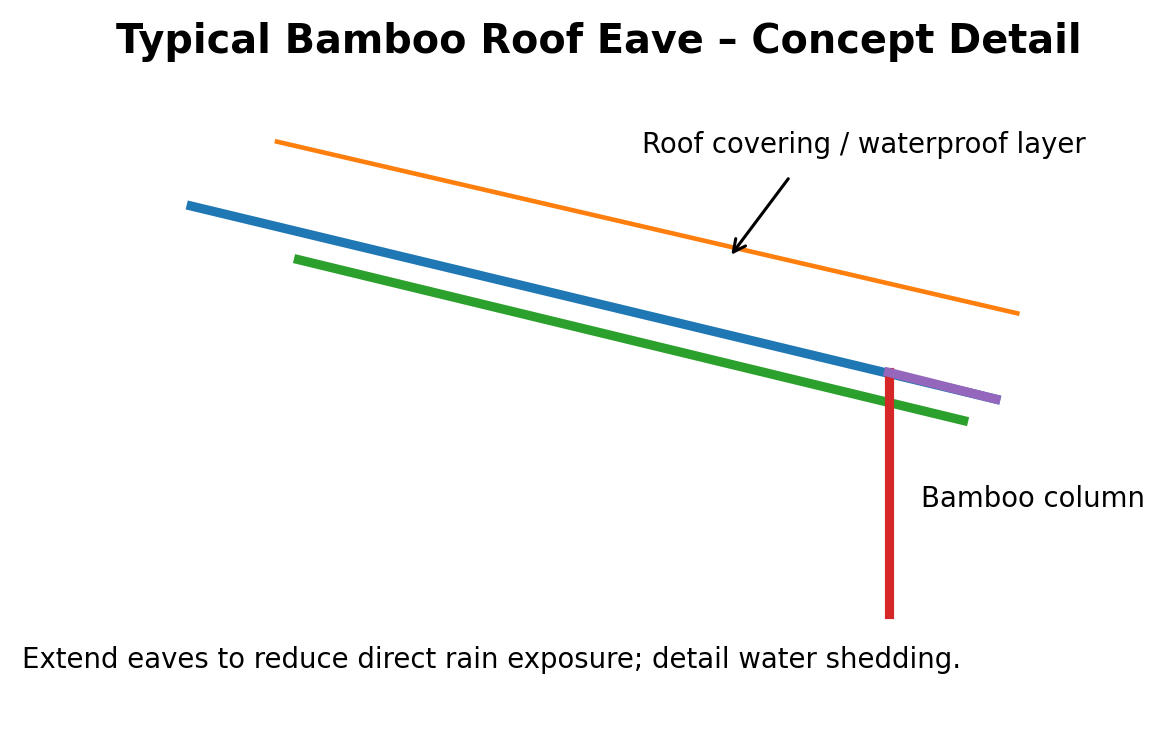
Roof eave
Roof overhangs can reduce direct weather exposure to bamboo members. The roof assembly should include a suitable weatherproof layer, positive drainage, flashing and carefully detailed connections. Wind uplift and lateral stability must be checked.
12 · Applications
Where bamboo belongs in contemporary architecture.
Bamboo can be paired with exposed concrete, brick, stone and glass to create contrast between natural texture and contemporary geometry. The material should be used where its performance, maintenance needs and detailing are understood.
- Structures
- Pavilions and lightweight structures
- Outdoors
- Pergolas and shaded outdoor spaces
- Landscape
- Landscape elements and garden shelters
- Interiors
- Screens, partitions and ceiling features
- Furniture
- Furniture and custom installations
- Hospitality
- Resort, hospitality and eco-tourism architecture
13 · Design considerations
Material honesty, with technical care.
Species selection, grading, moisture control, preservation, drying, connection design, weather protection and maintenance must be considered as one coordinated system.
The architectural value of bamboo lies not only in its natural appearance but in the design intelligence required to use it responsibly.
When these aspects are addressed through careful research and technical detailing, bamboo can become a meaningful component of contemporary architecture, bringing material honesty, warmth and a closer relationship with nature.
At Gyan Architects, we believe that good architecture begins with a deep understanding of materials and transforms that understanding into thoughtful, enduring spaces.
Technical note
Sources and limits of this article.
This article has been developed primarily from our Bamboo Report , including its guidance on species, selection parameters, inspection, treatment methods, drying and quality checks. The report does not provide engineered joint calculations, standardized connection capacities, certified structural test data or complete construction specifications. The joint and construction sketches shown are illustrative conceptual diagrams that explain architectural connection principles; they must not be used directly for construction.
All chemical treatments, preservation concentrations and structural applications should be checked against current product labels, applicable regulations, relevant standards, laboratory data and advice from qualified specialists.